

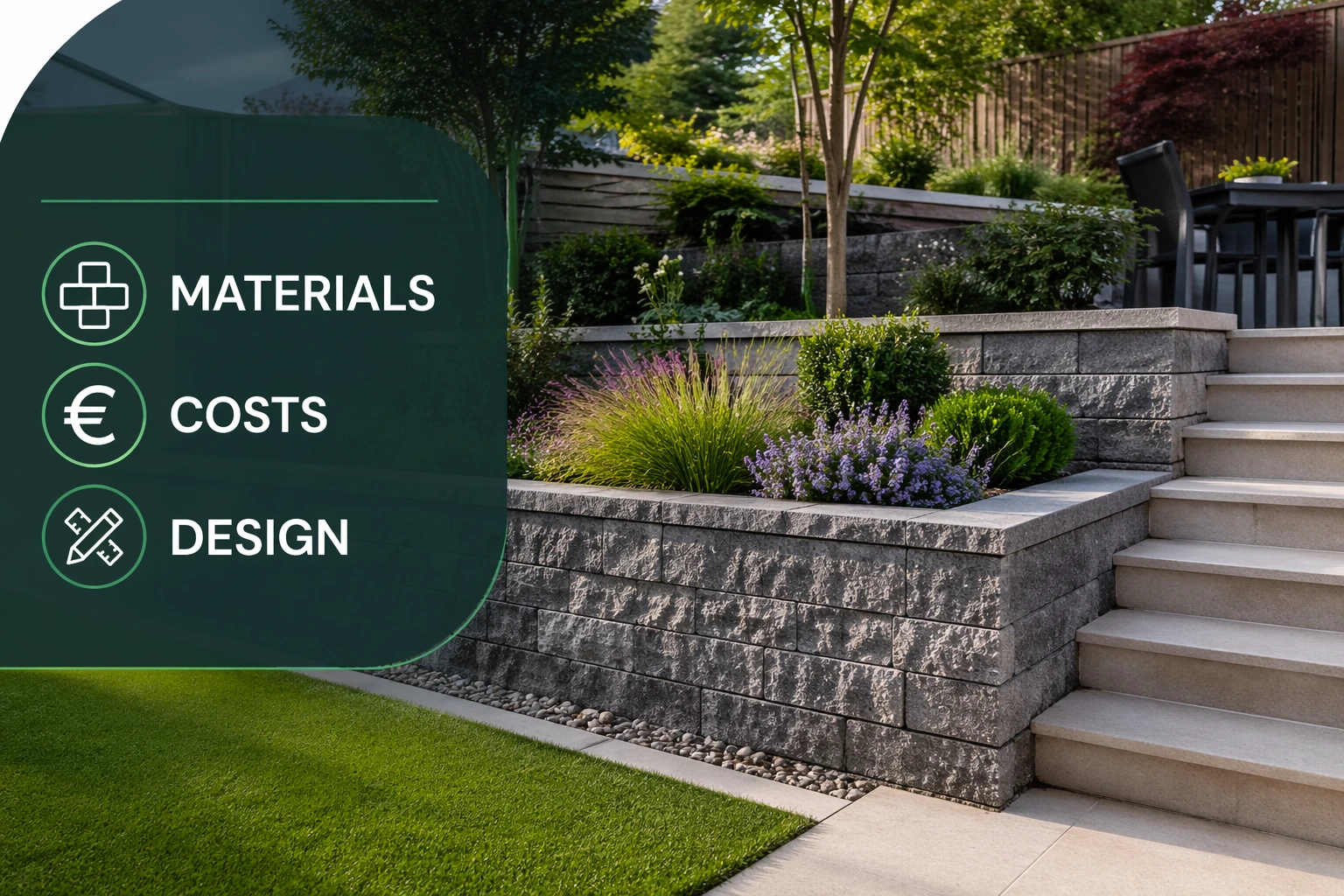
If your Dublin garden has a slope, uneven levels, or ground that drops away from the house, a retaining wall can transform an unusable space into a structured, functional garden. Retaining walls hold back soil, create flat terraces for patios and lawns, prevent erosion, and add architectural interest that elevates the entire garden design. They are one of the most impactful hard landscaping investments a Dublin homeowner can make.
At Lion Paving & Landscaping, we design and build retaining walls as part of garden renovation projects across Dublin and Kildare. This guide covers when you need a retaining wall, which materials to choose, realistic costs, and the critical design considerations that determine whether your wall lasts 5 years or 50.
When Do You Need a Retaining Wall in Your Dublin Garden?
Retaining walls solve several common problems in Dublin gardens. Gardens that slope away from the house, making the rear unusable. Level changes between your property and neighbouring properties. Soil erosion where ground washes downhill during heavy rain. The need to create flat areas for patios, dining spaces, or children’s play areas on sloped ground. And the desire to build raised planting beds that add structure and depth to flat gardens.
Many Dublin gardens — particularly those in estates built on hillsides in areas like Lucan, Clondalkin, Stepaside, Rathfarnham, and parts of South Dublin — have significant slopes that make the garden difficult to use without some form of retaining structure. Even a gentle slope across a 10-metre garden creates an unusable rear section that a retaining wall can reclaim as level, functional space.
Retaining Wall Materials: Which Is Best for Dublin?
Concrete Block (Rendered)
The most common and cost-effective choice for residential retaining walls in Dublin. Standard concrete blocks are laid on reinforced concrete foundations, then rendered (plastered) and painted or left in a neutral finish. This approach offers complete design flexibility — the rendered surface can be painted any colour to match your house or garden scheme. Rendered block walls suit both modern and traditional Dublin properties.
Cost: €150–€250/m² installed (including foundations, rendering, and coping)
Lifespan: 50+ years with proper foundations and drainage
Natural Stone
For a premium finish, natural stone retaining walls use limestone, granite, or sandstone blocks. They offer unmatched aesthetic appeal and integrate beautifully with natural stone patios. Stone walls can be built as mortared walls (with cement between stones) or dry-stone walls (stacked without mortar for a traditional look). Natural stone is heavier and more labour-intensive to install, but the result is a wall with genuine character that improves with age.
Cost: €250–€400/m² installed
Lifespan: 50–100+ years
Timber Sleepers
Railway sleepers or treated softwood sleepers stacked and bolted together create a warm, contemporary retaining wall. They are popular for lower walls (up to 600mm) and raised beds. Quick to install and cost-effective, though timber will eventually deteriorate in Dublin’s damp climate — expect 10–15 years from treated softwood and longer from hardwood sleepers.
Cost: €100–€200/m² installed
Lifespan: 10–15 years (softwood), 15–20 years (hardwood)
Gabion Baskets
Wire mesh cages filled with stone create a modern, industrial aesthetic. Gabion walls are naturally permeable (water drains through without building up pressure), quick to build, and make a bold design statement. They work best in contemporary gardens and are becoming increasingly popular in Dublin.
Cost: €180–€300/m² installed
Lifespan: 30–50 years
Retaining Wall Cost Comparison Table (Dublin 2026)
| Material | Cost/m² | Lifespan | Maintenance | Best For |
| Concrete block (rendered) | €150–€250 | 50+ years | Repaint every 5–10 years | Most residential projects |
| Natural stone | €250–€400 | 50–100+ years | Minimal | Premium finish, period properties |
| Timber sleepers | €100–€200 | 10–15 years | Re-treat every 3–5 years | Low walls, raised beds |
| Gabion baskets | €180–€300 | 30–50 years | None | Contemporary designs |
🧱
Need a Retaining Wall in Your Dublin Garden?
We design and build retaining walls in all materials — from rendered block to natural stone. Every wall includes reinforced foundations, proper drainage behind the wall, and a finish built to last decades.
Call us today: +353 85 778 0394
Or request a free quote on our contact page.
Critical Design Considerations for Retaining Walls
Drainage Behind the Wall
This is the most important — and most commonly overlooked — element of retaining wall design. Water builds up behind any retaining wall, and without adequate drainage, hydrostatic pressure will eventually push the wall forward, causing it to lean or collapse. Every retaining wall we build includes a gravel backfill layer and perforated drainage pipe behind the wall, discharging to a soakaway or storm drain. If your garden already has drainage issues, see our guide to fixing waterlogged gardens in Dublin.
Foundations
Retaining walls need reinforced concrete strip foundations sized to the height and loading of the wall. As a guide: walls up to 600mm need foundations at least 300mm deep and 450mm wide; walls 600mm–1.2m need foundations 450mm deep and 600mm wide; and walls over 1.2m should be designed by a structural engineer. We always build foundations that exceed minimum requirements, particularly given Dublin’s heavy clay soil conditions.
Height and Engineering Requirements
For retaining walls over 1.2m high, we recommend involving a structural engineer to calculate the forces involved and specify the wall construction. This is not just good practice — building regulations may require it, and your insurance may not cover a high wall that was not properly engineered. For walls under 1.2m, a competent landscaper with retaining wall experience can handle the design and build.
Coping and Finishing
The coping (top cap) of a retaining wall protects it from rain penetration and gives a finished look. Options include natural stone coping, precast concrete caps, brick bullnose, or timber. The coping should overhang the wall face slightly to shed water away from the wall surface, preventing staining and moisture ingress.
How Retaining Walls Transform Dublin Gardens
A well-designed retaining wall does far more than hold back soil. It creates distinct garden zones at different levels — a raised patio for dining, a lower lawn area for children, and tiered planting beds that add depth and dimension. Combined with garden steps for access between levels, retaining walls turn an awkward slope into one of the most interesting features of your garden. Many of the most striking gardens we have built across Dublin use retaining walls as the foundation of the entire design.
For inspiration, browse our project gallery or see how retaining walls combine with patios, fencing, and landscaping in our completed Dublin projects.
Frequently Asked Questions
Q: How much does a retaining wall cost in Dublin?
Retaining walls in Dublin typically cost €150–€400/m² depending on the material, height, and ground conditions. A simple 5m-long, 600mm-high rendered block wall costs approximately €1,500–€2,500. A longer, taller natural stone wall can reach €5,000–10,000 or more. See our 2026 landscaping price guide for a full breakdown.
Q: Do I need planning permission for a retaining wall in Dublin?
Generally, no, provided the wall is under 1.2m high and within your property boundary. Walls over 1.2m, walls near public roads, or walls in conservation areas may require planning permission. Always check with your local planning authority if you are unsure.
Q: How long does a retaining wall last?
Concrete block and natural stone retaining walls last 50–100+ years when properly built with adequate foundations and drainage. Timber sleeper walls last 10–15 years. The most common cause of premature failure is inadequate drainage behind the wall, not the wall material itself.
Q: Can I build a retaining wall myself?
Small walls under 400mm on stable ground can be a DIY project. However, any wall retaining significant soil pressure needs proper foundations, drainage, and engineering knowledge. A failed retaining wall is dangerous and expensive to fix — professional installation is strongly recommended for any wall over 400mm.
Q: What is the best retaining wall material for Dublin gardens?
Rendered concrete block offers the best balance of strength, cost, and design flexibility for most Dublin gardens. Natural stone is the premium choice for appearance and longevity. Timber sleepers are excellent for low walls and raised beds. The best choice depends on your budget, garden style, and the height required.
Get Professional Retaining Wall Installation in Dublin
At Lion Paving & Landscaping, we build retaining walls that last. Every project includes reinforced foundations, proper drainage, quality materials, and a finish that enhances your garden for decades. Browse our retaining wall service page or contact us for a free site visit and quote.
Call us: +353 85 778 0394
Email: sales@lionpavingandlandscaping.ie
Online: Request a Free Quote
Visit us: Get Directions
Lion Paving & Landscaping259 Birches Rd, Wedgwood, Dublin 16, D16Y5E5Serving North Dublin, South Dublin, Kildare & Surrounding Areas